1. Night Vision and Thermal Imaging: Two Different Imaging Principles
Although both technologies are designed to improve visibility in low-light or nighttime environments, their imaging principles are fundamentally different.
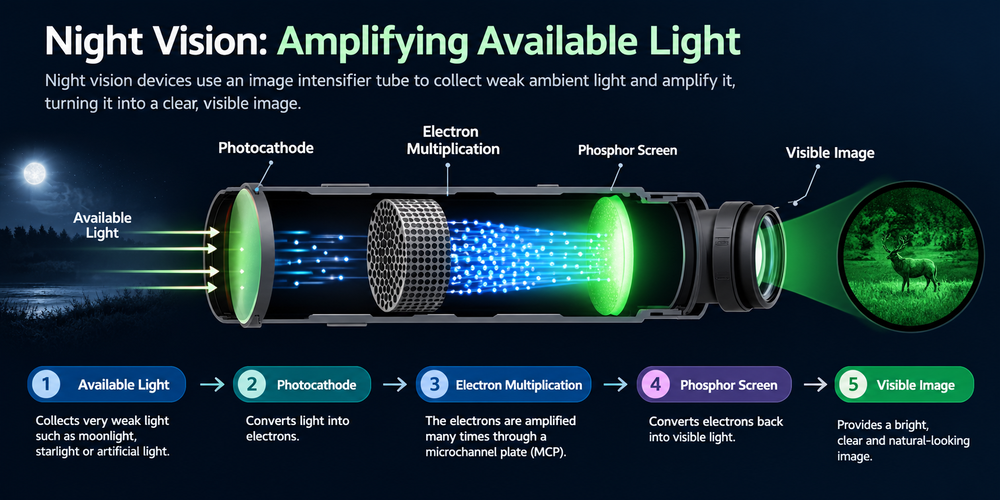
Night Vision: Amplifying Available Light
Traditional image-intensifier night vision systems collect very small amounts of available light, such as moonlight, starlight, or artificial light, and amplify the signal through an image intensifier tube.
The basic imaging process includes:
Available Light → Photocathode → Electron Multiplication → Phosphor Screen → Visible Image
This allows users to see a relatively natural representation of the surrounding environment.
The performance of an image-intensifier system is influenced by factors such as:
Image intensifier tube generation
FOM (Figure of Merit)
Resolution
Signal-to-noise characteristics
Photocathode sensitivity
Automatic gain control
Auto-gating
Objective lens performance
Eyepiece and optical system design
For professional night vision products, the image intensifier tube is one of the core components determining overall imaging performance.
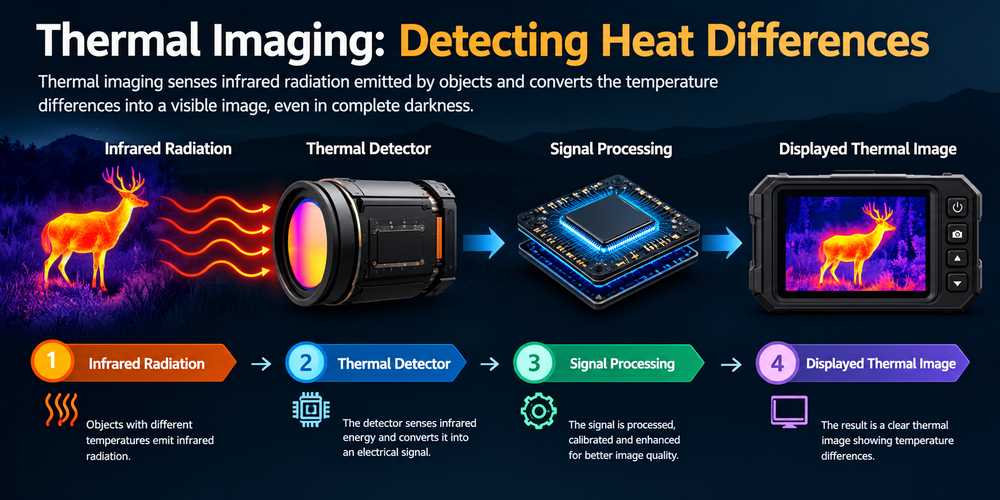
Thermal Imaging: Detecting Heat Differences
Thermal imaging works differently. Instead of amplifying visible light, a thermal detector senses infrared radiation emitted by objects and converts differences in infrared energy into an image.
This allows thermal imaging systems to operate without relying on visible ambient light.
People, animals, vehicles, engines and other objects with different temperatures from their surroundings can therefore create visible thermal contrast.
This makes thermal imaging particularly useful when the primary requirement is rapid detection rather than natural visual representation.
2. The Most Important Difference: Detection vs. Identification
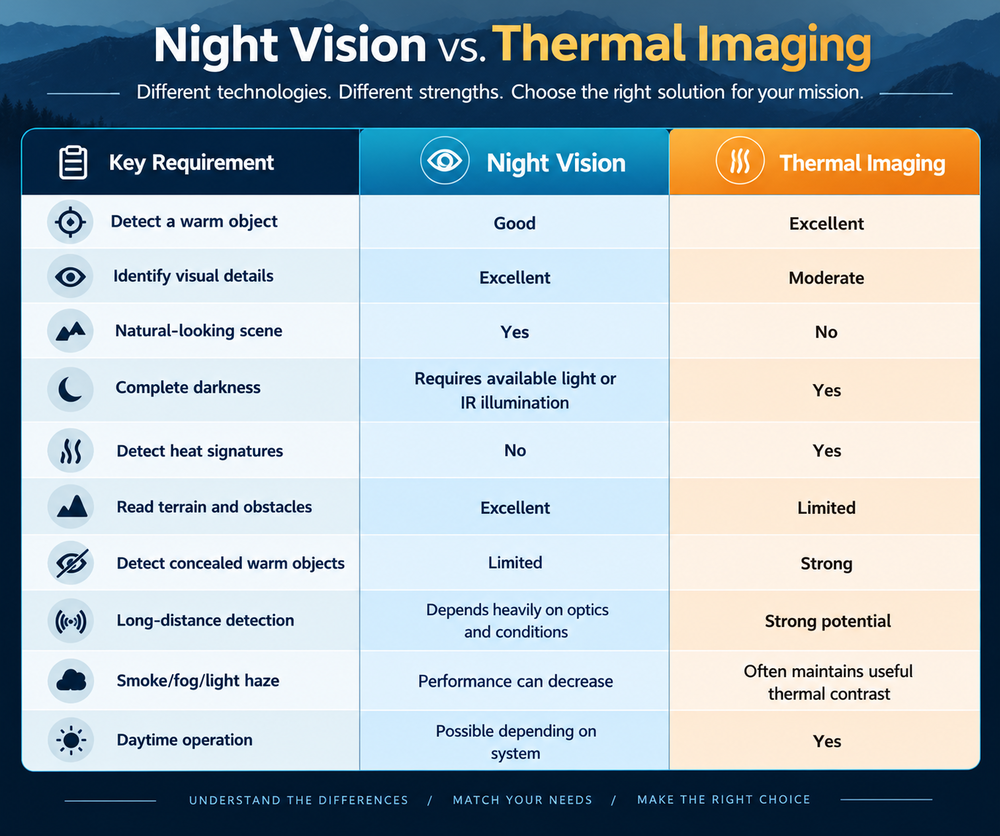
One of the most useful ways to compare the two technologies is to distinguish between detection and identification.
The key point is that a detected target is not necessarily an identified target.
Thermal imaging may quickly show that a warm object is present, while night vision can provide more surface and environmental detail for understanding what that object actually is.
3. Operating Conditions Matter
Another major selection factor is the environment in which the equipment will be used.
Night Vision
Night vision performs particularly well when there is sufficient ambient or infrared illumination.
Typical environments include:
Open outdoor areas
Low-light observation
Nighttime navigation
Wildlife observation
Security monitoring
Low-light vehicle operation
However, performance can be affected when available light becomes extremely limited or when atmospheric conditions significantly reduce optical visibility.
Thermal Imaging
Thermal imaging does not depend on visible light, making it suitable for:
Complete darkness
Nighttime surveillance
Search and rescue
Perimeter monitoring
Wildlife observation
Long-distance detection
Certain smoke, haze or fog conditions
However, thermal imaging also has limitations. Heavy rain, dense fog and low temperature contrast can reduce thermal performance, while glass and solid materials should not be assumed to be transparent to thermal radiation.
4.How Should You Compare the Specifications?
A common mistake is to compare only one specification.
For example, a buyer may ask:
“Which is better, 640×512 thermal or 1920×1080 digital night vision?”
This comparison alone is not sufficient.
Different imaging technologies use different principles, so the numbers cannot always be compared directly.
For Night Vision, Pay Attention To:
1. Image Intensifier Tube
The tube is the core imaging component in analog night vision.
2. FOM
FOM can be used as a useful reference for evaluating the combined performance of an image intensifier, although it should not be considered the only performance indicator.
3. Resolution
Higher resolution can improve the ability to distinguish fine details, but optical quality and other tube characteristics also matter.
4. Signal-to-Noise Ratio
Affects image clarity, particularly under very low-light conditions.
5. Auto-Gating
Helps control tube response when illumination conditions change rapidly.
6. Objective Lens
Focal length, aperture and optical quality influence field of view, light transmission and observation distance.
For Thermal Imaging, Pay Attention To:
1. Detector Resolution
Common configurations include 256×192, 384×288 and 640×512.
2. Pixel Pitch
12 μm and 17 μm are examples of commonly encountered detector configurations. Pixel pitch should be considered together with detector resolution and lens selection.
3. Thermal Sensitivity
A lower NETD value generally indicates better sensitivity to small temperature differences, although real-world performance also depends on environmental conditions and image processing.
4. Lens Focal Length
A longer focal length generally provides a narrower field of view and can be useful for longer-distance observation.
5. Field of View
A wider FOV can be useful for scanning and navigation, while a narrower FOV can support longer-distance observation.
6. Image Processing
Thermal image quality depends not only on the detector but also on signal processing, calibration and display technology.
Final Thoughts
Night vision and thermal imaging are not simply two versions of the same product. They are different imaging technologies designed to reveal different types of information.
Night vision focuses on available light and visual detail. Thermal imaging focuses on infrared radiation and thermal contrast.
Therefore, the right selection should not be based on a single specification such as resolution, FOM or detection distance.
Instead, buyers should evaluate the complete system:
At MHNV, we provide a broad range of night vision devices, image intensifier tubes, thermal imaging devices, optical components and fusion solutions for different observation requirements. With in-house R&D and manufacturing capabilities, we can also support OEM/ODM development and customized configurations according to specific project requirements.
The goal is not simply to choose a higher specification. The goal is to choose the imaging technology and configuration that matches the actual task.Let’s get in touch and discuss further.